

Is It Possible to Increase Head Without Changing Flow, or Increase Flow Without Changing Head?
A:
Customers often say things like this:
“The current flow rate is sufficient, but the pressure seems a little low. Can you increase the pressure without changing the flow rate?”
Or:
“The pressure is sufficient, but the flow rate seems a little low. Can you increase the flow rate without changing the pressure?”
So, can we meet this kind of requirement?
01
If the customer is saying:
“We previously purchased a pump from you with a head of 20 m and a flow rate of 1,000 m³/h. Now we want a pump with the same head but a flow rate of 1,250 m³/h.”
Or:
“We want a pump with a head of 25 m while keeping the same flow rate.”
Obviously, there is no difficulty with this type of request. We simply select and manufacture a pump according to the parameters provided by the customer.
However, we all know that this is probably not what the customer really means.
02
If the customer’s actual meaning is:
- The pump currently in operation has a discharge pressure of 0.2 MPa (approximately equal to 20 m head) and a flow rate of 1,000 m³/h, but the production process feels that the pressure is sufficient while the flow rate is a little too low. Can you keep the discharge pressure at 0.2 MPa unchanged and increase the flow rate to 1,250 m³/h?
Or:
The pump currently in operation has a discharge pressure of 0.2 MPa (approximately equal to 20 m head) and a flow rate of 1,000 m³/h, but the production process feels that the pressure is not quite sufficient. Can you increase the discharge pressure to 0.25 MPa (approximately equal to 25 m head) while keeping the flow rate unchanged?
Based on the customer’s intention, we need to discuss two situations: constant operating conditions and variable operating conditions.
Constant Operating Conditions
The water demand at the process end remains basically unchanged, meaning the required pressure and flow rate remain essentially constant.
For example, a cooling tower circulating pump system:
The pump draws water from a basin and delivers it to the cooling tower.
(Process flow: Water Basin → Pump → Cooling Tower)
This is the most common type of constant operating system. The height of the cooling tower does not change, and the downstream water requirements remain unchanged.
Variable Operating Conditions
The water usage conditions change frequently, meaning the required pressure and flow rate vary according to operating conditions.
For example, the supply pump system in a municipal water plant:
The pump delivers water from the water plant reservoir to consumers.
(Process flow: Water Plant Reservoir → Supply Pump → Consumers)
The main characteristic of this system is that end-user demand changes constantly, especially the flow rate.
① Constant Operating Conditions
When system demand remains basically unchanged, can the customer’s request be achieved?
Definitely not.
In more technical terms, after the pump performance curve and the system resistance curve are re-matched, both the actual flow rate and head will change. It is impossible for one parameter (either head or flow rate) to remain unchanged while the other changes.
In other words, the customer’s requirement is contradictory and cannot be achieved.
Customers may say they have seen this happen elsewhere and question your technical capability. If you can explain the principle clearly, that is ideal. If not, feel free to contact our specialists for assistance.
② Variable Operating Conditions
When system demand changes frequently, can the customer’s request be achieved?
Yes, it is generally possible.
This is most commonly seen in municipal water supply systems. Supply pumps are usually designed to maintain a constant discharge pressure while the flow rate adjusts automatically according to consumer demand.
Of course, simply replacing the pump alone cannot achieve this type of real-time adjustment. A Variable Frequency Drive (VFD) must be installed to assist.
There are also other variable-process applications where a constant flow rate is required while pressure changes according to operating conditions. In these cases, replacing the pump and adding a VFD are also necessary.
Summary
Under constant operating conditions, the customer’s requirement cannot be met.
Under variable operating conditions, the requirement can be met.
Therefore, it is essential to fully understand the customer’s process and operating conditions before proposing a solution.
For a more detailed explanation of the principles and implementation process, please contact Liancheng Pump Energy Saving Department at +86-21-5913-2577.
Characteristics of Intake Pumps and Supply Pumps in Water Treatment Plants
A: In Issue 7, we introduced the general process of municipal water supply. In this issue, we will take a closer look at the two most important groups of pumps in a water treatment plant: intake pumps and supply pumps.
1) Intake Pumps
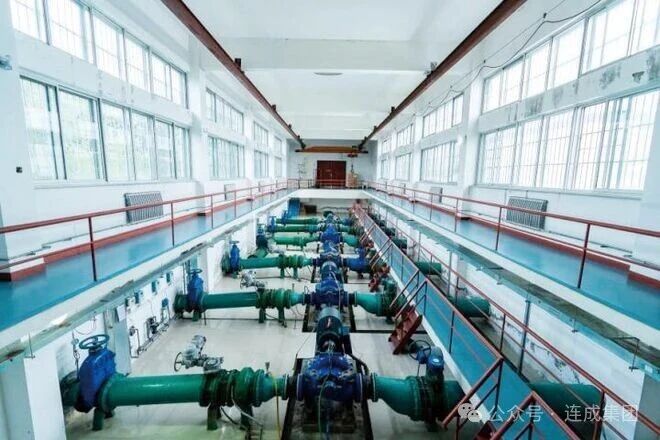
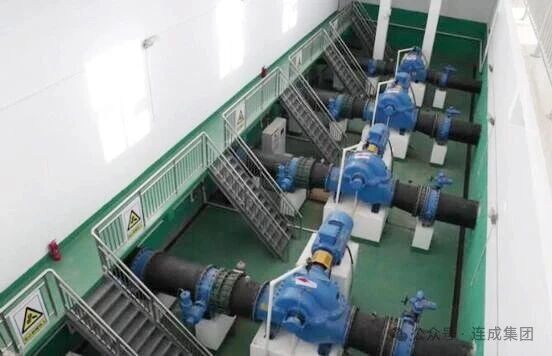
The function of intake pumps is to transport raw water from the water source to the water treatment plant.
Water Source → Intake Pump → Water Treatment Plant
The elevation difference between the intake pump station and the water treatment plant remains constant. The only variable is the water level at the source, but this fluctuation is relatively small. As a result, the system operates under stable conditions, and the pump discharge pressure and flow rate remain essentially unchanged.
Therefore, this operating condition can be regarded as a constant operating condition.
2) Supply Pumps
The function of supply pumps is to deliver treated water from the water treatment plant to consumers’ homes. (Some water treatment plants also supply water to factories and other facilities, but here we focus only on residential users.)
Treated Water from the Water Treatment Plant → Supply Pump → Consumers’ Homes
In this system, the demand at the end users changes significantly.
Residential water consumption varies:
- Throughout the day, with major differences between morning, noon, and evening usage.
- With the seasons, as summer and winter water consumption differ.
- During holidays, such as National Day and the Spring Festival, when usage patterns differ from normal periods.
This system is a typical variable operating condition.
The flow demand changes frequently, but the water pressure must be maintained within a specified range. Therefore, a Variable Frequency Drive (VFD) system is usually installed to maintain constant discharge pressure while allowing the flow rate to change according to demand.
The intake pumps and supply pumps described above are the largest and most important pumping equipment in a water treatment plant, and they are also the primary targets for energy-saving retrofit projects.
Post time: May-12-2026